

Plasma, Laser, Waterjet, EDM with edge or… E.cut?
Each of these cutting methods has specific areas where it is the best solution. Many metal cutting companies have one or more of these machines,
Almost always E.cut is a complementary machine to those already owned thanks to some characteristics that make it different.
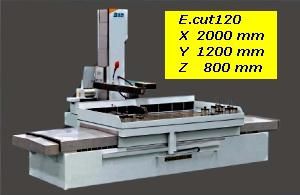
First of all, the cost of an Ecut. One of the smallest models, the 32, which can cut a figure of 400×320 mm up to 300 mm thick, costs just over 30,000 euros, (a conventional wire erosion costs 5 to 10 times as much).
The hourly cost of operation, (consumables, spare parts and maintenance for one year, power consumption < 3KVA), is by far the lowest of all the methods seen above.
Just these two factors, which can be summarized in one; Cost of operation + cost of amortization = 3 euros / hour suggest how revolutionary E.cut technology is.
E.cut is therefore not an alternative to one of these methods, but it is complementary to them.
The ability to cut 300 mm thick pieces already from the smallest models (some E.cut models cut thicknesses up to 1000 mm!) is where the difference in cost compared to any other method is great, often huge.
For some E.cut owners the competitive advantage means acquisition of new orders, or significant gains!
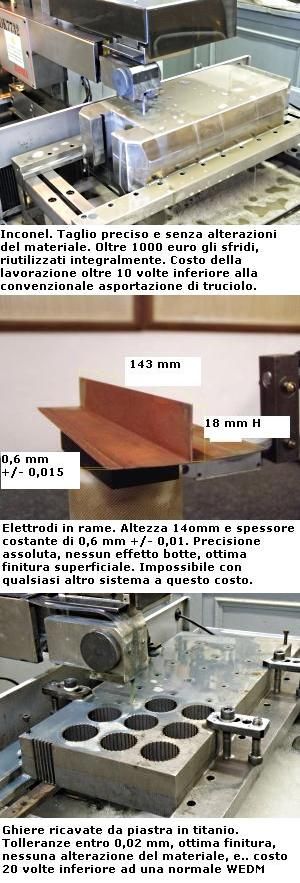
The precise cutting characteristics, ( +/- 0,015 mm ), perfectly cylindrical, ( no barrel effect nor conicity ), without superficial alterations, ( no hardening nor micro cracks ), and completely free from burrs, are unique to E.cut.
The recent adoption of a new CNC, installed on an industrial PC with Windows XP, guarantees an exceptional control of the cut. Extreme working conditions (wear-resistant metal coatings with blowholes) are brilliantly managed to avoid wire breakage.
The remote control allows you to control, verify, and control the machine from the office, or… from any device where installed a remote control software, (IPad, Galaxy, … tablet that go into the network ethernet!).